
Table of Contents
When sourcing pharmaceutical products from India, international buyers often come across terms such as manufacturer, pharmaceutical supplier, exporter, contract manufacturer, private-label manufacturer and sourcing partner.
Although these terms are sometimes used interchangeably, they can represent very different business models.
Understanding the difference is particularly important when sourcing Ivermectin 12mg tablets for pharmaceutical distribution, institutional procurement, government tenders or private-label projects.
The right procurement partner depends on your quantity, destination market, regulatory requirements, packaging, registration status and whether you require an existing product or a customized manufacturing arrangement.
This guide explains the differences between a pharmaceutical manufacturer, supplier/exporter and contract manufacturing partner, and provides a practical framework for choosing the right model for your requirement.
Regulatory note: Pharmaceutical products are subject to different registration, importation, licensing, labelling and distribution requirements in different countries. Buyers should independently verify the applicable requirements with the relevant regulatory authority before proceeding with a pharmaceutical procurement project.
Understanding the Pharmaceutical Supply Chain
A pharmaceutical product can move through several stages before reaching an importer, distributor or institutional buyer.
A simplified supply chain can look like:
Active pharmaceutical ingredient (API) → Manufacturing → Quality Control → Packaging → Regulatory Documentation → Export → Importer → Distributor/Institution
However, the company you communicate with may not perform every stage itself.
For example, a company presenting itself as a pharmaceutical supplier may source products from one or more manufacturing partners.
Similarly, an export company may coordinate pharmaceutical products, documentation and logistics without owning a manufacturing facility.
A contract manufacturing partner, on the other hand, may coordinate the production of a product according to agreed specifications, packaging and brand requirements.
Therefore, buyers should understand who actually manufactures the product, who is responsible for quality documentation and what role the supplier will play in the transaction.
What Is a Pharmaceutical Manufacturer?
A pharmaceutical manufacturer is an organization involved in the actual manufacturing of pharmaceutical products at an approved manufacturing facility.
Depending on the business arrangement, a manufacturer may be responsible for:
- Production
- Quality control
- Batch testing
- Manufacturing documentation
- Packaging
- Batch traceability
- Stability-related documentation
- Applicable manufacturing licences and certifications
For B2B buyers, verifying the actual manufacturing arrangement is important.
A buyer should not assume that every company describing itself as a “pharmaceutical manufacturer” directly manufactures every product listed on its website.
What Should Buyers Ask?
When evaluating an Ivermectin manufacturer or manufacturing partner, consider asking:
- Where is the product manufactured?
- Who is the actual manufacturing entity?
- What manufacturing standards apply?
- What product specifications are available?
- What quality documentation can be provided?
- Is batch-specific documentation available?
- What packaging configurations are possible?
- Can the manufacturer support the required quantity?
- Can destination-market documentation be provided where applicable?
The answers help establish whether the proposed manufacturing arrangement is suitable for your procurement requirement.
For general pharmaceutical manufacturing quality principles, buyers can also refer to the World Health Organization’s Good Manufacturing Practices (GMP) guidance.
What Is a Pharmaceutical Supplier?
A pharmaceutical supplier is generally a company that provides pharmaceutical products to buyers.
The supplier may:
- Manufacture products directly
- Source products from manufacturing partners
- Distribute products from pharmaceutical companies
- Coordinate contract manufacturing
- Handle export requirements
- Provide procurement and logistics support
This means the word supplier by itself does not tell you who manufactures the product.
For international buyers, this isn’t necessarily a problem.
A professional pharmaceutical sourcing partner can provide significant value by coordinating multiple parts of the procurement process.
However, buyers should understand the supply chain and know exactly which entity is responsible for manufacturing and quality.
What Is a Pharmaceutical Exporter?
A pharmaceutical exporter specializes in coordinating the international movement of pharmaceutical products from the exporting country to the destination market.
An exporter may coordinate:
- Commercial documentation
- Export documentation
- Shipping
- Customs documentation
- Freight arrangements
- Certificate of Origin
- Packing documentation
- Coordination with manufacturers
- Coordination with overseas importers
An exporter does not necessarily manufacture the pharmaceutical product.
Therefore, when evaluating an exporter, buyers should separately establish:
Who manufactures the product?
and
Who will handle the export and documentation process?
In some business models, these functions may be coordinated by the same organization. In others, they may involve different entities.
What Is a Contract Manufacturer?
A contract manufacturer produces pharmaceutical products according to an agreed commercial and technical arrangement between the manufacturing partner and the client.
Contract manufacturing can be particularly useful when a pharmaceutical company wants to develop or supply a product under its own commercial brand or according to specific requirements.
Depending on the project, contract manufacturing may involve:
- Product selection
- Strength and dosage-form requirements
- Manufacturing specifications
- Packaging configuration
- Artwork requirements
- Brand requirements
- Quality documentation
- Production planning
- Regulatory documentation
- Export coordination
The exact scope depends on the product, destination market and contractual arrangement.
What Is Private-Label Pharmaceutical Manufacturing?
Private-label manufacturing is a specific type of manufacturing arrangement where a pharmaceutical product is manufactured for a client’s brand or commercial programme, subject to applicable regulatory requirements.
A private-label project can involve several stages.
1. Product Selection
The buyer identifies the required product, strength and dosage form.
2. Market Evaluation
The destination country and applicable regulatory requirements are reviewed.
3. Packaging Requirements
The buyer determines the required:
- Pack size
- Blister configuration
- Carton design
- Labelling
- Language
- Regulatory information
4. Artwork
The product artwork is prepared according to the agreed specifications and applicable regulatory requirements.
5. Manufacturing
Production is coordinated according to the agreed specifications.
6. Quality Documentation
Applicable quality and batch documentation is prepared.
7. Export
Where applicable, the finished product is coordinated for international shipment.
Private-label projects generally require more planning than standard product procurement because the packaging, artwork, documentation and regulatory requirements may be customized.
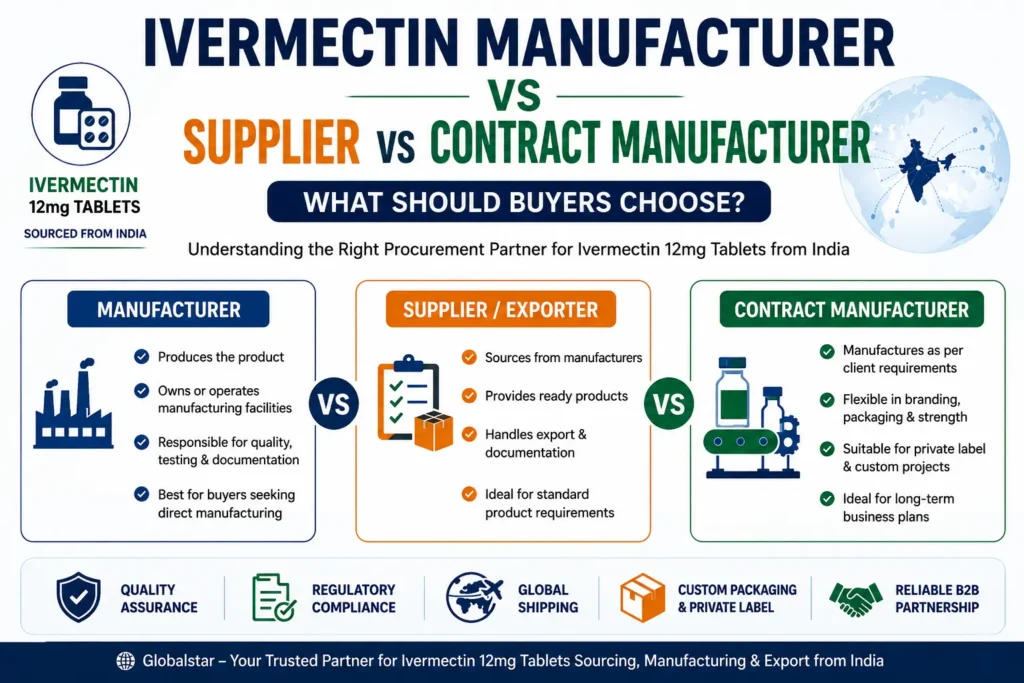
Manufacturer vs Supplier vs Contract Manufacturer
The differences can be summarized as follows:
| Business Model | Primary Role | Best Suited For |
|---|---|---|
| Pharmaceutical Manufacturer | Produces pharmaceutical products | Buyers seeking direct manufacturing arrangements |
| Pharmaceutical Supplier | Provides pharmaceutical products | Distributors and buyers seeking product sourcing |
| Pharmaceutical Exporter | Coordinates international export | International buyers requiring export support |
| Contract Manufacturer | Produces according to agreed client requirements | Pharmaceutical companies requiring customized manufacturing |
| Private-Label Manufacturer | Manufactures products for a client’s brand | Companies developing their own pharmaceutical brand |
| Sourcing Partner | Coordinates products and manufacturing sources | Buyers with broader procurement requirements |
These categories can overlap.
For example, one organization may provide sourcing, contract manufacturing coordination and export support as part of a single B2B procurement service.
Which Option Is Best for Ivermectin 12mg Procurement?
There is no single answer for every buyer.
The appropriate model depends on your requirement.
If You Need an Existing Product
If you are an established pharmaceutical distributor looking for an existing product specification, a pharmaceutical supplier or export partner may be appropriate.
Your primary considerations may include:
- Product availability
- Documentation
- Quantity
- Packaging
- Destination requirements
- Commercial terms
- Export capability
If You Need Large-Volume Procurement
For government tenders, institutional procurement and large distributor requirements, buyers should evaluate the supplier’s ability to support:
- Required quantity
- Production schedule
- Product specifications
- Quality documentation
- Packaging
- Delivery timeline
- Export documentation
For more information:
Ivermectin 12mg Bulk Supply for Government Tenders
If You Need Your Own Brand
If you require Ivermectin 12mg under your own brand, a contract manufacturing/private-label arrangement may be more appropriate.
The project may require additional planning around:
- Brand
- Packaging
- Artwork
- MOQ
- Regulatory requirements
- Product registration
- Production planning
If You Need to Import from India
If your primary challenge is understanding the import process, documentation and country-specific requirements, start with:
How to Import Ivermectin 12mg Tablets from India
How to Evaluate an Ivermectin Pharmaceutical Partner
Price should not be the only factor when evaluating an international pharmaceutical supply partner.
A lower quotation may not necessarily represent the best procurement option if documentation, packaging, regulatory support or production capability does not meet your requirements.
Consider the following factors.
1. Manufacturing Arrangement
Establish who actually manufactures the product and under what arrangement.
Ask for appropriate documentation supporting the proposed manufacturing source.
2. Product Specifications
Verify that the proposed product matches your required:
- Strength
- Dosage form
- Pharmacopoeial standard
- Packaging
- Shelf-life requirements
3. Quality Documentation
Ask what documentation is available for the product and relevant batches.
Depending on the project, this may include:
- COA
- Product specifications
- Applicable GMP documentation
- Stability information
- Manufacturing documentation
- Regulatory certificates where applicable
4. Regulatory Support
Determine what documentation can be provided for your destination market.
Do not assume that documentation required in one country will automatically satisfy another country’s regulatory authority.
5. Packaging Capability
Check whether the partner can support your required:
- Blister format
- Pack size
- Carton configuration
- Labelling
- Private-label artwork
6. Production Capability
For large procurement projects, establish whether the proposed manufacturing arrangement can support the required volume and delivery schedule.
7. Export Experience
International pharmaceutical procurement can involve multiple documents and logistics processes.
Evaluate whether the partner has experience coordinating international pharmaceutical shipments.
8. Communication and Transparency
A reliable procurement partner should clearly explain:
- Who manufactures the product
- What documentation is available
- What the MOQ is
- What the expected lead time is
- What is included in the quotation
- What regulatory responsibilities belong to the importer
Transparency at the beginning can prevent misunderstandings later.
Why Buyers Sometimes Prefer a Contract Manufacturing Partner
For pharmaceutical companies seeking their own brand, customized specifications or a structured long-term manufacturing arrangement, contract manufacturing may be more suitable than standard product sourcing. Learn more about Globalstar’s pharmaceutical contract manufacturing services
A contract manufacturing partner can be useful when a buyer wants more control over the final product and commercial presentation.
Compared with simply purchasing an existing product, contract manufacturing can potentially provide greater flexibility around:
- Brand
- Packaging
- Product specifications
- Order planning
- Production quantities
- Commercial supply arrangements
However, contract manufacturing is not automatically the best option.
If a buyer only needs a standard product for an established distribution programme, a standard B2B supply arrangement may be more efficient.
The correct model should therefore be selected based on the actual procurement objective.
Globalstar’s B2B Pharmaceutical Supply Model
Globalstar Company supports international B2B pharmaceutical requirements through a combination of:
- Pharmaceutical product sourcing
- Contract manufacturing coordination
- Private-label/OEM projects
- Bulk pharmaceutical procurement
- Tender-related supply support
- Documentation coordination
- Packaging requirements
- Export support
- International shipment coordination
Our role is to help qualified international buyers evaluate and coordinate pharmaceutical procurement requirements from India.
Depending on the project, Globalstar may coordinate with appropriate pharmaceutical manufacturing partners to meet the buyer’s product, quantity, packaging and destination-market requirements.
Important
The manufacturing entity, applicable certifications and available documentation can vary depending on the specific product and manufacturing arrangement.
For this reason, buyers should evaluate the documentation applicable to their actual product and project rather than relying only on general statements about a supplier.
Ivermectin 12mg Contract Manufacturing
For pharmaceutical companies considering their own brand or customized B2B supply arrangement, contract manufacturing can provide an alternative to purchasing an existing branded product.
A project may involve:
Requirement → Product Evaluation → Regulatory Review → Packaging → Commercial Agreement → Manufacturing → Quality Documentation → Export
The exact process depends on the destination market and project requirements.
For more information:
Ivermectin 12mg Contract Manufacturing & Export
Iverstar 12mg USP Tablets
For buyers evaluating an existing Ivermectin 12mg product, Globalstar’s Iverstar 12mg USP Tablets page provides product-specific information.
View Iverstar 12mg USP Tablets
For bulk procurement, tender or institutional requirements, buyers should provide their estimated quantity, destination and required documentation so that the appropriate supply arrangement can be evaluated.
Frequently Asked Questions
What is the difference between an ivermectin manufacturer and supplier?
A manufacturer is involved in producing the pharmaceutical product, while a supplier provides the product to the buyer. A supplier may manufacture products directly or source them from manufacturing partners. Buyers should verify the actual manufacturing arrangement for the product they are purchasing.
Is a pharmaceutical exporter the same as a manufacturer?
Not necessarily. An exporter may coordinate international shipments, documentation and logistics without manufacturing the product itself. Some organizations may coordinate both manufacturing and export activities.
What is ivermectin contract manufacturing?
Ivermectin contract manufacturing refers to an arrangement where a pharmaceutical manufacturing partner produces the product according to agreed requirements between the manufacturing partner and client, subject to applicable regulatory and commercial conditions.
Can I get Ivermectin 12mg under my own brand?
Eligible private-label projects can be evaluated based on the destination market, product requirements, quantity, packaging, documentation and applicable regulations.
How do I choose an ivermectin supplier from India?
Evaluate the actual manufacturing arrangement, product specifications, quality documentation, regulatory requirements, packaging capability, MOQ, production planning, export experience and communication transparency rather than relying solely on price.
What documents should I request from an ivermectin pharmaceutical supplier?
Depending on the project, buyers may request product specifications, COA, applicable GMP documentation, stability information, manufacturing documentation and regulatory certificates where applicable. The exact documentation required depends on the destination market and procurement programme.
Need Help Choosing the Right Pharmaceutical Supply Model?
If you are a pharmaceutical importer, distributor, government-tender participant, institutional buyer or pharmaceutical company, share your requirement with Globalstar.
Please provide:
- Destination country
- Product requirement
- Required quantity
- Existing brand or private-label requirement
- Packaging requirement
- Tender document, if applicable
- Expected delivery timeline
- Required regulatory documentation
Our team can evaluate whether your requirement is better suited to standard pharmaceutical sourcing, bulk supply, contract manufacturing or private-label manufacturing.
Start a B2B Procurement Discussion
Submit Your Pharmaceutical Enquiry
Regulatory Disclaimer
Pharmaceutical products are subject to different regulatory, registration, importation, licensing and distribution requirements in different countries.
The availability of a product, manufacturing arrangement, documentation and export option depends on the applicable requirements of the destination market.
Globalstar provides pharmaceutical sourcing, contract manufacturing coordination and export support for qualified B2B requirements. Buyers are responsible for ensuring that their procurement, importation and distribution activities comply with the laws and regulatory requirements applicable to their market.