

Table of Contents
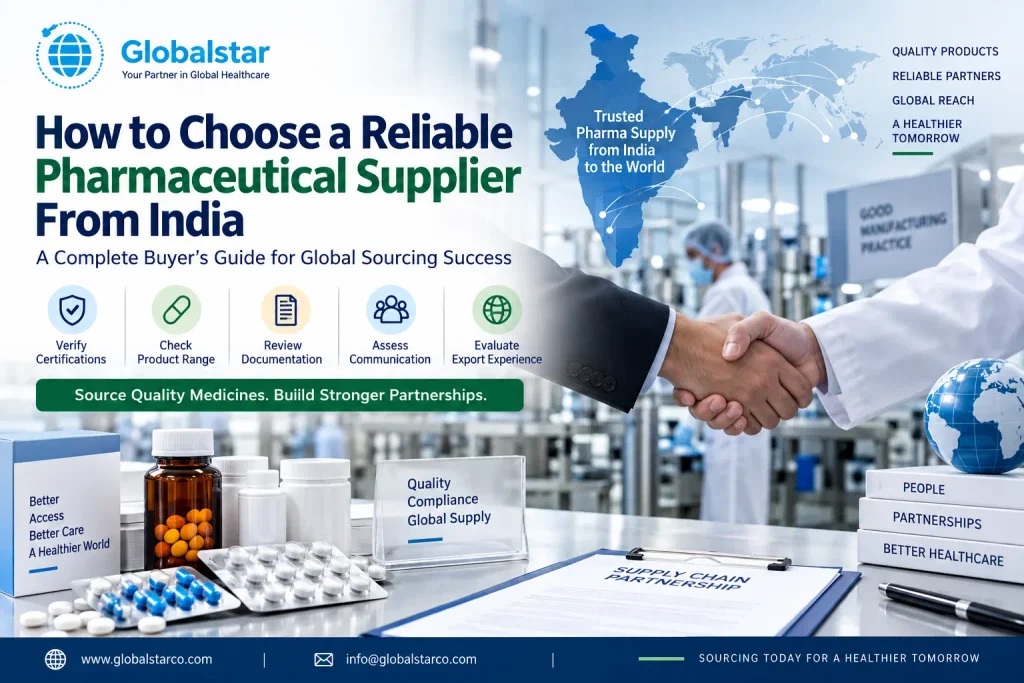
🏥Introduction
India is an important sourcing market for pharmaceutical products, but choosing the right supplier requires more than comparing a product list or the lowest quotation. International buyers need to evaluate the supplier’s manufacturing source, product documentation, export capability, commercial terms, communication and ability to meet destination-market requirements.
Whether you are a pharmaceutical importer, distributor, hospital, pharmacy group, tender buyer or brand owner, a structured supplier-evaluation process can reduce avoidable delays and documentation problems. This guide explains the key factors to review before placing an order with a pharmaceutical supplier from India.
1. Verify Certifications and Manufacturing Documentation
Buyers should verify the certifications and manufacturing documentation applicable to the specific product and manufacturing facility. Depending on the product and destination market, this may include GMP documentation, applicable ISO certifications, manufacturing licences, product-specific approvals, certificates of pharmaceutical products and stability or batch-testing documentation.
The important point is not simply whether a supplier displays a certificate, but whether the documentation relates to the actual product, manufacturing facility and destination-market requirements. Buyers should request relevant documents and confirm that the company, manufacturing site, product category and validity details are consistent.
For information on good manufacturing practices, refer to the World Health Organization (WHO) Good Manufacturing Practices guidance.
Globalstar Co works with established pharmaceutical manufacturing partners in India and coordinates sourcing, documentation and export requirements for international buyers. The relevant manufacturing and product documentation is evaluated according to the buyer’s product and destination-market requirements.
2. Check the Pharmaceutical Product Range and Therapeutic Coverage
A rA reliable pharmaceutical supplier should be able to clearly explain the products it can source, the available strengths and pack sizes, and the manufacturing or supply arrangements behind those products. Depending on the supplier’s network, the portfolio may include tablets, capsules, oral liquids, ointments, injectables, topical creams and other healthcare or surgical products.
For importers and distributors, broader sourcing capability can make it easier to consolidate requirements through one export partner. However, buyers should evaluate each product individually rather than assuming that every item in a supplier’s catalogue comes from the same manufacturer or carries the same approvals.
Explore the pharmaceutical product range to review the broader sourcing categories.
3. Evaluate Export Documentation Capability
Export documentation is a major part of pharmaceutical procurement. Before placing an order, ask the supplier which documents can be provided for the specific product and shipment.
Certificate of Analysis (COA), where applicable
Certificate of Origin (COO)
Free Sale Certificate or other applicable product documentation
Material Safety Data Sheet (MSDS/SDS), where applicable
Commercial invoice and packing list
Applicable manufacturing or GMP documentation
Product test, stability or batch-related reports where required
The exact documentation package varies according to the product, manufacturer, shipment and destination country. A capable export partner should be able to explain what is available before the order is confirmed rather than discovering documentation requirements at the shipping stage.se costly delays.
4. Compare MOQ, Pricing, Packaging and Lead Times
Before finalizing a partner, evaluate:Price alone is not a reliable way to compare pharmaceutical suppliers. A lower quotation may reflect a different formulation, strength, pack size, packaging specification, minimum order quantity or documentation scope.
When comparing quotations, check whether each supplier is quoting on a like-for-like basis, including:
Product name, formulation and strength
Pack size and quantity
Primary and secondary packaging
Minimum Order Quantity (MOQ)
Required documentation
Lead time and production schedule
Incoterms and shipping terms
Freight and destination-related requirements
For larger orders, buyers should also ask about production planning, supply continuity and how changes in packaging or specifications will be handled.
5. Assess Communication Speed and Professionalism
Good communication is especially important when pharmaceutical orders involve multiple products, technical specifications, documentation and regulatory requirements. A reliable supplier should provide clear quotations, respond to questions consistently and identify the relevant manufacturing or sourcing arrangement when appropriate.
Before committing to a large order, assess whether the supplier can provide clear product information, documentation samples where appropriate, realistic lead times and a defined point of contact. Professional communication at the quotation stage is often a useful indicator of how efficiently an order will be handled later.
Globalstar Co supports international buyers with product sourcing, quotation coordination, documentation and export communication through its established manufacturing and supply network.ated support for international distributors.
6. Review International and Regional Export Experience
Export experience matters because pharmaceutical requirements can vary between destination markets. Buyers should ask whether the supplier has experience handling the documentation, packaging, shipping and commercial requirements relevant to their market.
Globalstar Co works with international buyers across multiple regions, with product availability and documentation evaluated according to the destination market. For importers and distributors, this can be particularly useful when a shipment involves multiple products or requires coordination with manufacturing partners.
Learn more about support for pharmaceutical importers and distributors.
How to Verify a Pharmaceutical Supplier Before Placing an Order
- Confirm the supplier’s legal company identity and business contact details.
- Ask who manufactures the specific product and where the manufacturing facility is located.
- Request the relevant product and manufacturing documentation for review.
- Check that product specifications, pack sizes and proposed labels match the quotation.
- Compare MOQ, pricing, lead time, payment terms and shipping terms in writing.
- Clarify which party is responsible for export documentation and destination-market requirements.
- Use a purchase order or contract that clearly records the agreed specifications and commercial terms.
Red Flags When Choosing a Pharmaceutical Supplier
Be cautious if a prospective supplier:
- Cannot clearly identify the manufacturer or manufacturing source for the quoted product.
- Makes broad certification claims but is unwilling to provide relevant supporting documentation.
- Offers an unusually low price without clearly defining product specifications and pack size.
- Provides inconsistent company, manufacturer or product information across quotations and documents.
- Cannot give a realistic MOQ or production lead time.
- Changes product specifications or commercial terms without clear explanation.
- Is unable to explain which documents will accompany the shipment.
Pharmaceutical Supplier vs. Pharmaceutical Manufacturer: What Is the Difference?
A pharmaceutical manufacturer produces the medicines at its manufacturing facility, while an exporter, supplier or sourcing partner may coordinate procurement and export through one or more manufacturing partners. For buyers, the important issue is to understand who is responsible for manufacturing the specific product and which company is responsible for export coordination.
Globalstar Co operates as a pharmaceutical export and sourcing partner and coordinates with established manufacturing partners in India. This model can help international buyers source multiple products while receiving coordinated commercial and export support.
Can Globalstar Support Private-Label and Contract Manufacturing?
Depending on the product, market and manufacturing requirements, Globalstar Co can coordinate private-label and contract-manufacturing requirements through its manufacturing partners in India. This may include product sourcing, packaging coordination, artwork, documentation and export support.
For a detailed overview, see pharmaceutical contract manufacturing in India. You can also review the pharmaceutical contract manufacturing service.
🟢Conclusion: Choosing the Right Partner Shapes Your Business Success
Choosing a reliable pharmaceutical supplier from India should be based on more than price or catalogue size. International buyers should verify the relevant manufacturing documentation, understand the product and packaging specifications, assess export documentation capability, compare quotations on a like-for-like basis and evaluate communication before placing an order.
For importers, distributors, hospitals, tender buyers and brand owners, a dependable export partner can simplify coordination between the buyer, pharmaceutical manufacturers and shipping process. Globalstar Co supports international sourcing and export requirements through its network of established manufacturing partners in India, with product and documentation requirements assessed according to the destination market.
❓FAQs: Pharmaceutical Suppliers From India
What should I verify before choosing a pharmaceutical supplier from India?
Verify the supplier’s company details, manufacturing source, relevant product and manufacturing documentation, product specifications, MOQ, pricing, lead time, export documentation and communication process. The documentation should relate to the specific product and manufacturing facility wherever applicable.
What certifications should a pharma supplier have?
The appropriate certifications and manufacturing documents depend on the product, manufacturing facility and destination market. Buyers may need to review applicable GMP documentation, ISO certifications, manufacturing licences, product approvals and other market-specific documents. Always request and verify documents relevant to the actual product and facility.
What documents are needed for pharmaceutical exports?
Common export documents can include a commercial invoice, packing list, certificate of origin and product-specific documentation such as a Certificate of Analysis or applicable certificates and reports. Exact requirements vary by product, shipment and destination country.
How can I verify whether a pharmaceutical supplier is legitimate?
Confirm the legal company identity and contact details, identify the manufacturing source, request relevant documentation, compare the information across quotations and documents, and clarify who is responsible for manufacturing and export. Avoid relying only on website claims or catalogue listings.
How should I compare pharmaceutical supplier quotations?
Compare like-for-like specifications including formulation, strength, pack size, packaging, MOQ, documentation, lead time, Incoterms, freight and destination requirements. A lower unit price is not necessarily a lower total procurement cost.
What is the difference between a pharmaceutical exporter and a manufacturer?
A manufacturer produces the product at its manufacturing facility. An exporter or sourcing partner may coordinate procurement and international shipment through manufacturing partners. Buyers should confirm who manufactures the specific product and who is responsible for export coordination.
Can Globalstar support private-label or contract manufacturing?
Depending on the product and destination-market requirements, Globalstar Co can coordinate private-label and contract-manufacturing projects through established manufacturing partners in India, including sourcing, packaging coordination, documentation and export support.